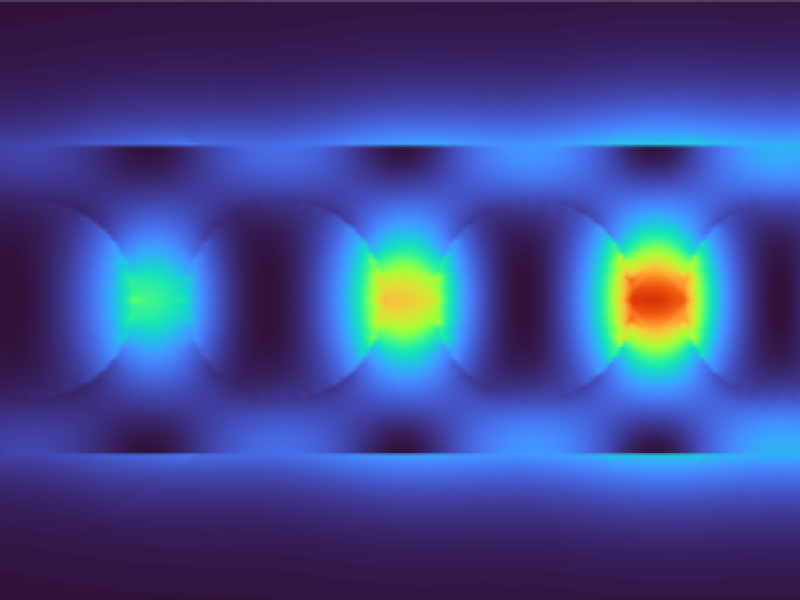
The project Multiscale Cavities for Photonic Quantum Technologies is a project within the Partnership Area Energy Transition (AA-Ener-1, 01/2026-12/2028) of the Berlin Mathematics Research Center MATH+ (DFG excellence cluster EXC-2046/1, project ID: 390685689), headed jointly by researchers from TUB (Stephan Reitzenstein) and ZIB (Felix Binkowski, Sven Burger).
Quantum states carry essential information in quantum information technologies. In photonic quantum technology (QT), single and entangled photons serve as flying qubits and allow for tap-proof quantum communication as well as for interlinking components of quantum computers. Ever more complex nanophotonic resonators will allow for the controlled generation, manipulation, storage, and detection of photonic qubits. In particular, integration of monolayer materials to nanophotonic cavities plays an important role to achieve novel capabilities. Such quasi two-dimensional layers provide high carrier mobilities allowing for highly efficient devices with high modulation speed.
Numerical methods are required for optimizing integrated nanophotonic resonators. Essentially, Maxwell’s equations need to be solved in an eigenproblem formulation for achieving resonance wavelength and quality factor of a cavity, and they need to be solved in a light scattering formulation in order to obtain coupling strengths and Purcell factors for quantum emitters placed in the cavities. These problems are posed on 3D geometries which exhibit multiple scales. Typically, the spatial extent of a resonator is in the range of several micrometers in all dimensions, while also sub-nanometer structured layers are included.
The goal of this project is the numerical simulation and optimization of single-photon sources and integrated devices which are characterized by large 3D computational domains including sub-nanometer structures, by multimodal optical response functions, and by material dispersion leading to nonlinear eigenproblems. In particular, systems realized experimentally at TUB based on design input from ZIB will be investigated, with focii on optimization of Purcell enhancement exploiting multi-modal interference and bound-states-in-the-continuum. Feedback from experiment will be provided to benchmark the numerical methods.